Print Ready Artwork
What is print ready? It is a term used to depict that the file you are supplying is ready to print as you intend. In more detail, this is that the artwork that has been created is the right size, the right colour setting (CMYK), the fonts are included or outlined, there is sufficient margin and bleed and the image resolution is at least 300dpi.
Let’s explain that further.
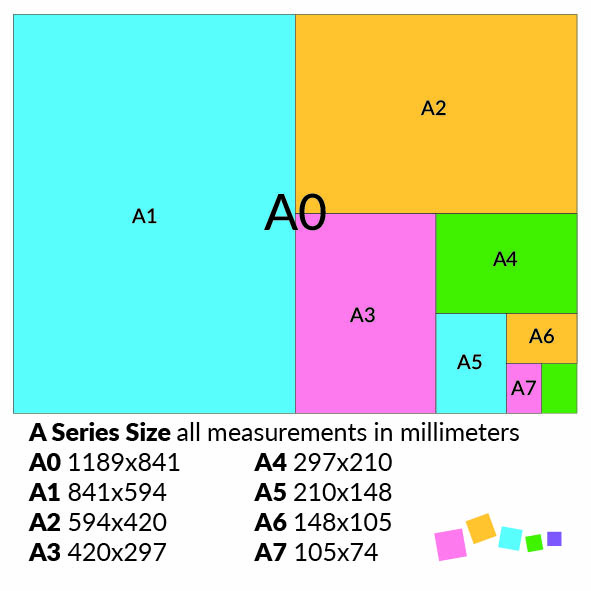
A chart showing paper sizes
The right size: This is important to try and achieve. Setting artwork to the right size means that we don’t have to resize it to fit. If this is the case and we do have to resize then the image quality can change or potentially we may have a result where the image has to be stretched out one way more than the other (known as out of proportion).
You can get the right size in many software packages. It will be most likely known as page size or document size. Do a quick search within the program to find this and give yourself a good starting point. We also have created some templates for you to start with under “Find Out More” in our individual product information.
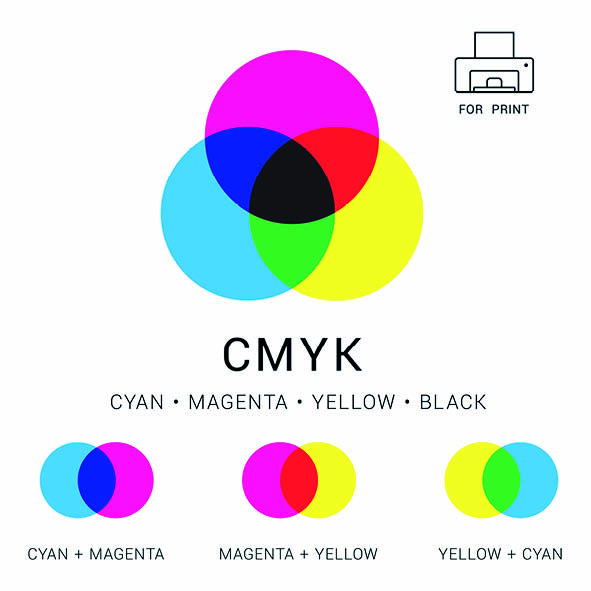
CMYK - the colour setting used for print
The right colour setting: Commonly, printers print the four main colours known as CMYK (Cyan, Magenta, Yellow & Black). The four main colours when combined at different percentage amounts create a rainbow of many colours. Some software will give you the chance to change the colour setting to CMYK or they will be fixed to RGB (Red, Green & Blue). When providing artwork in RGB, a conversion will occur to get ready for print which isn’t always exact so will cause a colour change. We recommend changing to CMYK first so you know exactly what will be printed or ask for a digital proof to check the output.
Fonts
The fonts are included or outlined: This is not always possible with standard software such as Word but is something you can do with designer programs. We recommend if you are not using standard style fonts which are more fancy than traditional fonts that you create a PDF file that includes the fonts when exporting. You should get an alert if the font cannot be included therefore we recommend that the font is changed or converted to an outline so no longer a font and now more of a wire diagram of the shape, or you could convert the document to an image which will then make all fonts become images so will not change.
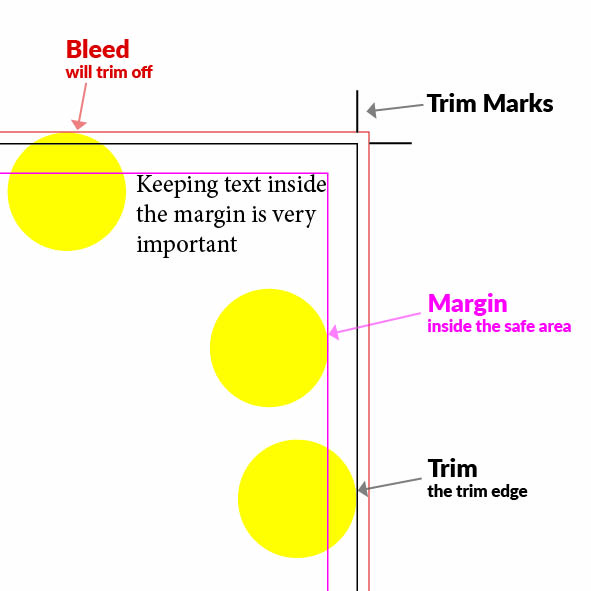
Margin and Bleed
There is sufficient margin and bleed: Known as the area outside of the important information. Bleed is the area that is bigger than the finished size that we use to cut into so the image looks like it is edge to edge. The reason for this is that we print multiple copies up on a sheet and then cut them out afterwards. Margin is the area just after the trim line which we recommend keeping safe of important information such as text. It not only ensures there is no chance the text will be cut into but also looks comfortable within the space. Cosmetically, it can look unpleasant being close to the edge and not well balanced. We recommend a 2mm bleed and 5mm margin on documents up to A3 in size. Above this, up to A1, we recommend a 5mm bleed and 15mm margin. Above this, we would recommend a 15mm bleed and a 50mm margin. The reason for these adjustments is that the bigger you go the more error adjustment is needed to help with finishing the final print e.g. trimming, and to ensure the balance is maintained.
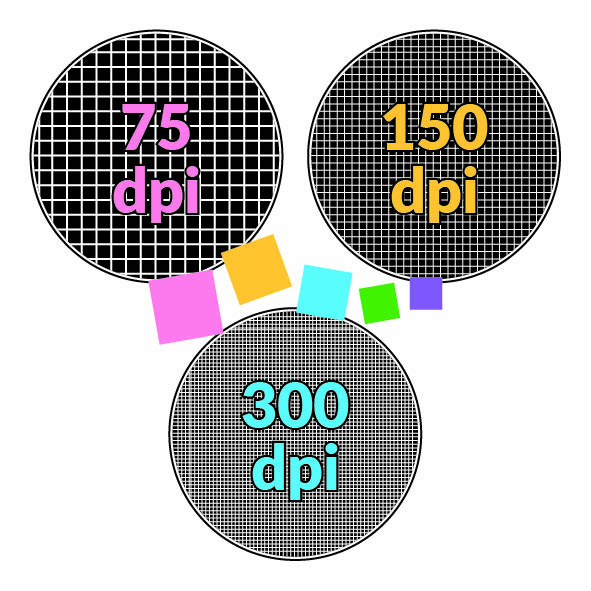
DPI
Image resolution is at least 300dpi: Lots to take in here, we shall start with the dpi. 300dpi meaning how many dots per inch make up the image. The more dots the more detail you can see. The less dots the lesser the detail so your artwork will look poorer quality. So with that in mind, this should help you understand what we mean by resolution. It is the term commonly used to suggest the quality of an image. Something worth thinking about here is that not only is the image that quality but is also the intended size you wish to print it. For instance, if you have a 300dpi image but need to double its size to print it will no longer be 300dpi it is now 150dpi because you have stretched it out. The dots haven’t changed, only that there is now less in each inch.
With all this taken into consideration, you should now have the tools to be print-prepared to create a print-ready file and be print-confident.
