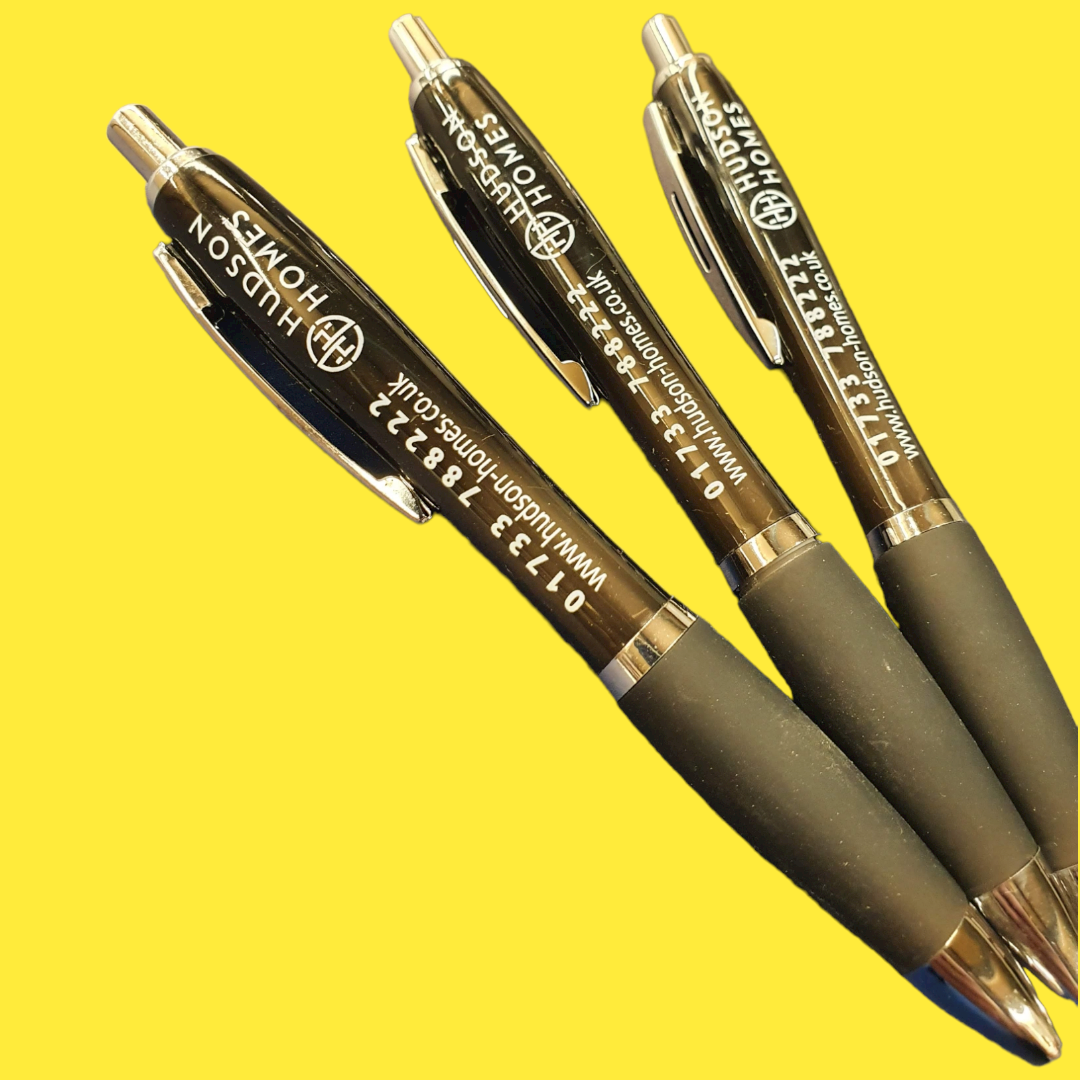


Full Colour Print
Print area: 60 x 6mm
Writing ink colour: Black
Estimated turnaround 20 working days
OptionsDye Sublimation
A process where heat turns solid ink into a gas, which then bonds with a polymer coating on the product. This allows for high-definition, full-colour, edge-to-edge printing that won't peel or fade. These are applied manually by hand so won't be precision placement.
Digital UV Printing
This method uses Ultra-Violet light to instantly cure dry ink as it is printed onto a surface. It allows for high-quality, full-color images to be printed directly onto hard surfaces.
Pad Printing One Colour - 4 Colour Option
Think of this like a giant rubber stamp. A silicone pad picks up ink from an etched plate and "stamps" it onto the product. Because the pad is flexible, it can wrap around curved surfaces.
Laser Engraving
Technically not a "print," this uses a high-powered laser beam to etch the top layer of a material away, revealing the metal or colour underneath.
Screen Printing One Colour - 4 Colour Option
Screen printing is the "old school" gold standard of the branding world. It involves pushing ink through a woven mesh stencil (a screen) onto a substrate. While digital printing has made waves recently, screen printing remains the heavyweight champion for bulk orders and vibrant, tactile designs.
Digital Transfer Printing UV DTF
This method combines the high-resolution quality of UV Printing with the flexibility of a Transfer. Instead of printing directly onto the object, the design is printed onto a special "A" film with UV-curable inks and a varnish layer. A laminator then applies a "B" film the carrier.
The result is essentially a "high-performance, 3D-effect rub-on transfer" that requires no heat to apply. These are applied manually by hand so won't be precision placement.
Solvent Printing
Solvent printing is a digital inkjet process that uses pigment-based inks where the carrier liquid is an oil-based chemical solvent. Unlike water-based (aqueous) inks, the solvent actually softens the surface of the printing material—usually vinyl—allowing the pigments to chemically bond with the substrate.
As the solvent evaporates, it leaves the pigment deeply embedded in the material, making it incredibly rugged.
Event & Display Hardware
No downloads available or can't find what you're looking for. Contact us at info@gpprint.co.uk for more information
No downloads available. Contact info@gpprint.co.uk for templates.
No reviews for this product yet.
Want to leave a review? Use the reviews page (you will receive a link from your order email), or contact us for a direct link.
